

Table of Contents
- Quick Comparison: Best Offroad Upgrades for Toyota 4Runner
- 4Runner Suspension Lift Kits: The Foundation of Any Build
- 4Runner Skid Plates and Armor: Protecting the Undercarriage
- Best All-Terrain Tires for 4Runner and Wheel Fitment
- 4Runner Recovery Gear Essentials and Winch Bumpers
- Weight, Payload, and Fuel Economy: What Mods Really Cost You
- Legal, Insurance, and Maintenance Considerations for Modified 4Runners
- Conclusion
- Frequently Asked Questions
Last Updated: September 30, 2026
Quick Comparison: Best Offroad Upgrades for Toyota 4Runner
The best offroad upgrades for Toyota 4Runner start with suspension, tires, and armor, then add recovery gear and storage. The best offroad upgrades for Toyota 4Runner start with suspension, tires, and armor, then add recovery gear and storage.
| Upgrade | Typical Cost | Priority | What It Fixes |
|---|---|---|---|
| Suspension lift | $3,499.95-$4,299.95 | First | Ground clearance, tire fitment |
| Skid plates and armor | $429.98-$1,449.00 | Second | Undercarriage damage |
| All-terrain tires | Varies by size | Second | Traction, puncture resistance |
| Recovery gear and bumpers | $899.99-$1,949.00 | Third | Getting unstuck, front protection |
| Roof rack and storage | $949.99 | Fourth | Gear capacity, weight balance |
4Runner Suspension Lift Kits: The Foundation of Any Build
A suspension lift unlocks everything else: it raises ground clearance, improves approach and departure angles, and creates room for larger tires. Without it, bigger tires rub and your undercarriage stays low.
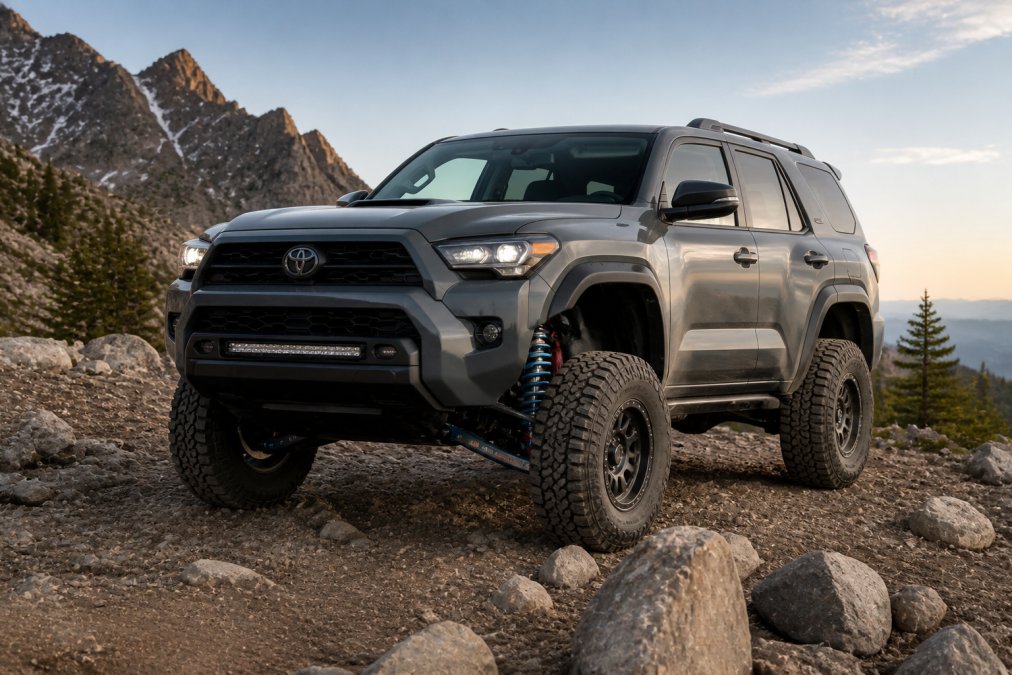
SST2.1 vs SST3.3: Which Lift Fits Your Terrain
The SST2.1 Suspension System is designed for comfort and control in various driving conditions. The SST3.3 Suspension System offers Falcon 3.3 Fast Adjust shocks with multiple settings for adaptable performance.
4Runner Skid Plates and Armor: Protecting the Undercarriage
Undercarriage protection is the upgrade owners skip and then wish they hadn't. One sharp rock against your oil pan or transfer case turns a trail day into a tow bill. Armor is cheaper than a repair, every time.
Rock Sliders and Front Skid Plate Protection
For 2025–2026 Toyota 4Runner rock sliders, side steps, skid plates, and other protection upgrades, verify generation-specific mounting points and current availability before ordering. Browse currently available Toyota 4Runner upgrades.
Best All-Terrain Tires for 4Runner and Wheel Fitment
Tires are where your 4Runner meets the trail. All-terrain tires handle pavement, gravel, and moderate rock without mud-terrain noise; mud-terrains win in deep mud and loose rock but howl on the highway and wear faster. For a daily-driven 4Runner on weekend trails, an all-terrain in the 285/75R17 range is the sweet spot.
All-Terrain Tires Worth Running on a 4Runner
Three tire families dominate 4Runner builds:
- BFGoodrich All-Terrain T/A KO2, the default for mixed pavement and trail use. Three-ply sidewalls resist punctures, the tread is quiet enough for daily driving, and it comes in most 4Runner-friendly sizes. The trade-off is weight; a 285/75R17 KO2 is noticeably heavier than a stock-size tire.
- Falken Wildpeak A/T3W, a strong wet-weather and snow performer with a softer ride than the KO2. Popular with overlanders who drive long highway stretches to reach trails. Wear is slightly faster under heavy loads.
- Toyo Open Country A/T III, a good balance of on-road manners and off-road grip, with a longer treadwear warranty than most all-terrains. A common pick for 4Runners that spend more time on pavement than dirt.
For mud-terrain, the BFGoodrich Mud-Terrain T/A KM3 and Toyo Open Country M/T are the names you'll see most. Run them only if you wheel in deep mud or loose rock, the highway noise and faster wear are real costs.
Load Range, Speed Rating, and Sizing Rules That Matter
Load range is the spec most buyers ignore. A Load Range C tire is lighter and rides softer, suiting a mostly stock 4Runner. A Load Range E tire resists punctures and handles heavy loads better, but it's stiffer and heavier, on a lightly loaded 4Runner it can make the ride harsh and cost fuel economy. Match load range to your actual build weight, not the biggest number on the sidewall.
Fitment rules that matter:
- Match tire size to your actual lift height, not the advertised number
- Keep offset close to factory to avoid rubbing on the UCAs
- Recheck clearance at full steering lock after installation
- Air down to 15-20 psi on trails for grip and a softer ride, then air back up for the highway
- Confirm the tire's speed rating is appropriate for your highway driving; most all-terrains are rated well above legal highway speeds, but check before you buy
Air-Down and Tire Pressure Management
Air pressure is the cheapest off-road upgrade you'll ever make. Dropping from 35 psi to 18-20 psi increases the tire's contact patch, improving traction on rock and sand and softening the ride over washboard. The trade-off is heat buildup at speed, so air back up before the highway.
Carry a way to air down and back up:
- A quality deflator or valve-core tool for fast, even air-down
- A portable 12V air compressor rated for the volume of your tires, a 35" tire takes meaningfully longer to fill than a stock-size one
- A tire pressure gauge you trust, checked against a second gauge
Tire and wheel fitment guide
Shop Toyota 4Runner Upgrades →
4Runner Recovery Gear Essentials and Winch Bumpers
Recovery gear gets you home when traction fails. The essentials are a winch, recovery straps, a hi-lift or bottle jack, traction boards, and an emergency kit with first aid supplies. Store it where you can reach it without unpacking the whole truck, a recovery bag in the cargo area beats gear buried under a rooftop tent.
The Recovery Toolkit: What to Carry and Why
A winch is only one part of a recovery system. Build the rest of the kit around it:
- Recovery straps and shackles, a kinetic recovery rope or strap rated well above your vehicle's weight, plus rated D-ring shackles. Never use a tow strap with metal hooks for a kinetic pull; the stored energy can turn a hook into a projectile.
- Traction boards, a pair gets you out of sand, snow, and mud without a winch, and doubles as a leveling surface for a jack on soft ground.
- A hi-lift or bottle jack, a hi-lift is versatile but unforgiving; a bottle jack is safer and easier for most trail-side tire changes. Carry a base plate so the jack doesn't sink.
- A tree saver strap and snatch block, a tree saver protects the anchor and the tree, and a snatch block doubles your winch's pulling power or changes the pull direction.
- Gloves, a dampener, and a shovel, a winch line dampener (or heavy jacket) reduces the whip if a line fails, and a shovel clears the tires before you pull.
Winch Bumpers for the 6th Gen 4Runner
A winch needs a bumper that can carry it. Two options fit the 6th Gen 4Runner through Lee Mods.
Front Bumper Options for Winch and Lighting
The Centric bumper offers recovery capability while retaining factory styling and sensor/fog light locations. The Overland Series is designed for extensive lighting setups, supporting a 40" light bar and Baja Designs Squadron fog lights, though factory fog lights are not supported.
Winch Sizing and Line Choice
Match your winch to your bumper and vehicle weight. A common rule of thumb is a winch rated at least 1.5 times your loaded vehicle weight, for a built 4Runner, usually a 10,000-12,000 lb winch. A bumper rated for 12,000 lb paired with a lighter unit wastes capacity, while an undersized bumper can't handle a heavy winch under load.
Winch and recovery safety guidance
Weight, Payload, and Fuel Economy: What Mods Really Cost You
Every upgrade adds weight, the hidden cost of a build. Steel bumpers, sliders, skid plates, a winch, and a rooftop tent can add several hundred pounds before you load a single duffel bag, eating into payload capacity and fuel economy.
- How much does this part add?
- What's my remaining payload after it's installed?
- Does the benefit justify the fuel economy hit?
Legal, Insurance, and Maintenance Considerations for Modified 4Runners
Modifications affect more than performance, they touch your insurance, warranty, and state inspection rules. Getting this wrong can cost you a claim or leave you unable to register the vehicle.
- Alignment check immediately after installation and again after the suspension settles
- Re-torque suspension hardware after the first few hundred miles
- Inspect sway bar end links and relocation brackets at every oil change
- Check tire pressure more often, especially if you air down regularly
- Inspect skid plates and sliders for loose hardware after hard trail use
Conclusion
Building a 4Runner that handles real trails takes planning, not just a parts list. The right order is suspension first, armor and tires second, recovery gear third, and storage last, with weight, insurance, and maintenance checked at every step.

Frequently Asked Questions
What are the best off-road mods for the Toyota 4Runner?
Start with a suspension lift like the ReadyLIFT SST2.1 or SST3.3, then add skid plates, rock sliders, and all-terrain tires. A winch bumper and recovery gear round out a capable build. These offroad upgrades improve clearance, protection, and self-recovery without compromising daily drivability.
Are Toyota 4Runners good for off-roading?
Yes. The 4Runner's body-on-frame chassis, solid rear axle, and available four-wheel drive make it a strong platform. With the right offroad upgrades, such as a suspension lift and skid plates, it handles trails, rocks, and overlanding routes well. The 6th Gen continues this with modern tech and improved articulation.
What is the first modification you should do to a 4Runner?
Skid plates and rock sliders are often the first armor upgrades, protecting the undercarriage and rocker panels. If you plan to run larger tires, a suspension lift comes first to clear them. Recovery gear essentials like a winch and D-ring mounts should follow before you hit remote trails.
Do 4Runner suspension lift kits affect fuel economy?
Lifting a 4Runner increases frontal area and rolling resistance, which can reduce fuel economy by 1-3 mpg depending on tire size and driving conditions. Heavier armor and bumpers add weight, further impacting efficiency. Choosing lightweight options like aluminum skid plates helps minimize the penalty.
Will offroad upgrades void my 4Runner's warranty or affect insurance?
Aftermarket parts can affect warranty coverage if they cause a related failure. For insurance, notify your provider about major modifications like lift kits and bumpers, as they may adjust premiums or require additional coverage.
Ready to upgrade your truck or SUV?
Shop Lee Mods' stocked Featured Truck & Off-Road Picks, with fitment guidance before you order.
Shop Featured Truck & Off-Road Picks →