

Table of Contents
- Why Buying Custom Truck Accessories Online Makes Sense in 2026
- How to Verify Truck Accessory Fitment Before You Buy
- Performance vs Aesthetic Truck Upgrades: Which Comes First?
- Top Custom Truck Accessories to Consider
- Truck Accessory Installation Tips for DIY Enthusiasts
- Legal and Regulatory Compliance for Truck Modifications
- Conclusion
- Frequently Asked Questions
Last Updated: September 21, 2026
Why Buying Custom Truck Accessories Online Makes Sense in 2026
The shift toward buying custom truck accessories online has fundamentally changed how enthusiasts build their rigs. Instead of driving between local shops hoping they stock the right part, you can now compare fitment data, read owner reviews, and order exactly what fits your truck, all from your phone. This guide from Lee Mods covers what actually matters when you shop online: fitment verification, product categories worth prioritizing, and the installation and legal details most buyers overlook.
The biggest advantage is selection. A local retailer might carry two or three bed cover options for your model. An online catalog can show you a dozen, with specs, materials, and real customer feedback attached to each listing. That breadth matters when you're spending real money on parts you'll live with for years.
The tradeoff is that you can't physically inspect anything before buying. That's why fitment verification and return policies deserve more attention than flashy product photos.
How to Verify Truck Accessory Fitment Before You Buy
Fitment verification is the process of confirming that a specific accessory matches your truck's year, make, model, cab configuration, and bed length before you order. Skipping this step is the single most common reason for returns and frustration.
Reading Fitment Charts and Vehicle Lookup Tools
Most reputable retailers offer a vehicle lookup tool where you enter your truck's details and see only compatible parts. Use it every time, even if a product listing says "universal." Universal rarely means what you hope it means.
Check these details before ordering:
- Year, make, and model (a 2019 vs. 2020 refresh can change mounting points)
- Cab style (regular, extended, crew cab)
- Bed length (short, standard, long)
- Drivetrain (2WD vs. 4WD affects suspension and clearance)
- Existing modifications that might interfere with mounting
Questions to Ask Before Ordering
A common mistake is assuming that because a part fits your model year, it fits your specific truck. Trim levels and factory packages change what's already installed.
Ask these before you click buy:
- Does this require drilling, or does it use existing factory holes?
- Will it work with my current bumper or running boards?
- What's the return policy if fitment is wrong?
- Does the listing include all installation hardware?
Performance vs Aesthetic Truck Upgrades: Which Comes First?
Performance upgrades improve how your truck drives, tows, and handles, while aesthetic upgrades change how it looks. The right order depends entirely on how you use the vehicle.
If you're building an overlanding rig, function leads. Suspension, tires, and lighting come before cosmetic touches. If you're personalizing a daily driver, appearance might be the priority, and that's a legitimate choice. There's no wrong answer, only a wrong sequence for your goals.
Here's a simple way to decide:
| Your Goal | Start With | Add Later |
|---|---|---|
| Off-road capability | Suspension, tires, skid plates | Bumpers, lighting |
| Daily driver style | Wheels, grille, interior trim | Bed cover, running boards |
| Towing and hauling | Suspension, brake upgrades | Bed liner, tie-downs |
| Overlanding | Suspension, tires, bed storage | Lighting, roof rack |
The practical advice: decide your end goal before buying anything. Parts that work for a street build often don't suit an off-road one, and vice versa.
Top Custom Truck Accessories to Consider
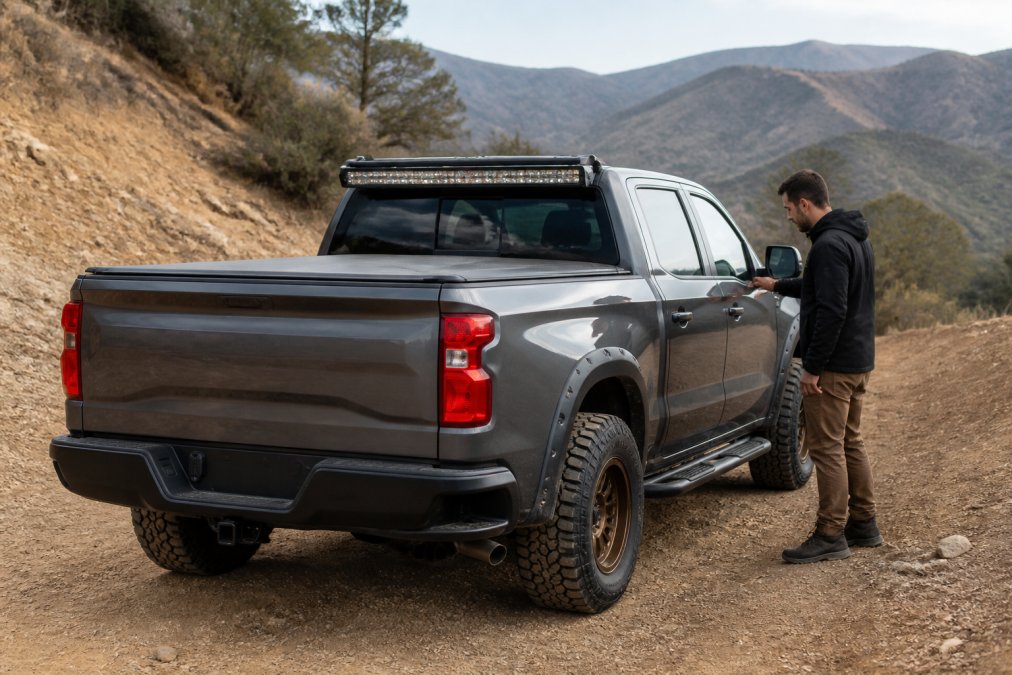
The categories below cover the upgrades most owners prioritize. Each entry notes what it does and what to look for.
Exterior Upgrades: Bed Covers, Bumpers, and Lighting
Tonneau covers protect cargo and improve fuel economy by reducing drag. The three main types trade security against convenience:
- Soft roll-up: Lightest and cheapest, typically $200-$400. Easy to remove, but a knife is all it takes to get in.
- Hard folding: Aluminum or composite panels, usually $700-$1,200. Locks, supports some weight on top, and folds forward for partial bed access.
- Retractable: Rolls into a canister at the cab, $1,200-$2,000. Best security and cleanest look, but the canister eats bed space.
Bumpers and grille guards add protection and change your truck's stance. Aftermarket bumpers often include winch mounts and recovery points that factory bumpers lack. Steel bumpers are available in plate, tube, or winch-ready designs; aluminum versions are also available and can save weight. Bull bars and grille guards suit trucks that see highway miles and occasional trail use.
LED light bars and off-road lighting dramatically improve visibility on dark trails.
Suspension and Wheel Packages for Off-Road Capability
Lift kits and leveling kits raise your truck's ride height. A leveling kit corrects the factory rake with spacers up front. A full lift kit adds real ground clearance for larger tires and usually includes new shocks, springs, and sometimes control arms. Tire clearance and wheel offset both matter here, get them wrong and you'll deal with rubbing on every turn.
Interior, Bed Protection, and Towing Gear
Interior customization ranges from seat covers and floor liners to full dash kits and aftermarket head units. All-weather floor liners are a high-value first purchase for many owners. Dash kits and trim overlays let you change the look without pulling the factory panels.
For most builds, suspension and tires deliver the biggest real-world improvement per dollar. Cosmetic upgrades can wait until the functional foundation is solid.
Truck Accessory Installation Tips for DIY Enthusiasts
Most bolt-on accessories install with basic hand tools, but the real question is whether a given job is worth doing yourself. The difficulty ratings below are a practical starting point, your comfort level and available tools should decide the rest.
DIY Difficulty Ratings by Accessory Category
| Accessory | Difficulty | Typical Time | Tools Needed |
|---|---|---|---|
| Floor liners, seat covers | Easy | 15-30 min | None |
| Tonneau cover (clamp-on) | Easy | 30-60 min | Socket set |
| Running boards / side steps | Easy-Moderate | 1-2 hrs | Socket set, jack stands |
| LED light bar (wiring included) | Moderate | 2-4 hrs | Drill, wire crimpers, fuse tap |
| Grille guard / bull bar | Moderate | 2-3 hrs | Socket set, torque wrench |
| Leveling kit | Moderate-Hard | 3-5 hrs | Jack, stands, spring compressor |
| Full lift kit | Hard | 6-10 hrs | Full shop tools, alignment after |
| Bumper with winch mount | Hard | 4-8 hrs | Grinder, torque wrench, two people |
Practical Tips That Separate a Clean Install From a Frustrating One
Start by reading the instructions completely before touching a wrench. Lay out all hardware and confirm nothing is missing. Work on a flat, solid surface, and use jack stands if you're lifting the vehicle.
- Apply thread locker to bolts on parts that see vibration, like light bars and bumpers
- Torque fasteners to the manufacturer's spec, not "tight enough", suspension and bumper hardware especially
- Test-fit before final tightening, especially on bed covers and running boards
- Use dielectric grease on electrical connections for lights and winches to prevent corrosion
- Keep your factory hardware; you may need it if you remove the accessory later
When to Hand It Off to a Shop
If a job requires cutting, welding, or modifying the chassis, that's usually the point to hand it off to a professional. The same goes for anything that changes suspension geometry, a lift kit that isn't followed by a proper alignment will chew through tires fast. DIY saves money on bolt-on parts. It rarely saves money on structural work, and a bad install can void the warranty on the part and on related factory components.
Before starting any suspension job, photograph the factory setup from multiple angles. Reassembly is far easier when you have a reference, and the photos help if you ever need to return the truck to stock.
Legal and Regulatory Compliance for Truck Modifications
Modification laws vary by state, and ignoring them can cost you at inspection or on the road. Lift height limits, bumper height rules, and lighting regulations are the most common sticking points.
Conclusion
Building your truck the way you want takes patience, research, and a willingness to verify fitment before every purchase. The payoff is a rig that looks right, performs better, and holds up to real use.
Frequently Asked Questions
What should I look for when buying custom truck accessories online?
Focus on fitment data, material quality, and return policy. Verify that the product is specifically designed for your vehicle's year, make, and model. Check for corrosion-resistant finishes like powder coating. Read reviews about durability and ease of installation. Ensure the seller offers a clear return process and warranty. Reliable online stores provide detailed specifications and vehicle lookup tools to confirm compatibility before purchase.
How do I ensure aftermarket truck parts will fit my vehicle?
Use the seller's vehicle lookup tool by entering your VIN or selecting year, make, model, and trim. Cross-reference part numbers with manufacturer catalogs. Look for notes about required modifications or additional hardware. For suspension parts, check if they work with your existing setup. If unsure, contact customer support with your vehicle details. Many online retailers offer fitment guarantees, so confirm this before ordering.
Are online truck accessory stores reliable for shipping large parts?
Reputable online stores use freight carriers for large items like bumpers and bed covers. They provide tracking and insurance. Check shipping policies for handling times and delivery estimates. Some offer free shipping on orders over a certain amount. Read customer reviews about packaging and condition on arrival. If damage occurs, a good return policy covers replacements. Always inspect deliveries promptly and report issues immediately.
What are the most popular custom truck accessories for beginners?
Beginners often start with bed liners, tonneau covers, running boards, and LED light bars. These upgrades are bolt-on, require minimal tools, and improve functionality or appearance. Bed liners protect the truck bed from scratches. Tonneau covers secure cargo and improve fuel efficiency. Running boards ease cabin access. LED light bars enhance visibility off-road. All are widely available and have straightforward installation guides.
Shop parts by your exact vehicle
Start with year, make, and model so you can focus on products that match your build.
Shop by Vehicle