

Table of Contents
- Why Visual Similarity Is Not Enough to Verify Vehicle Part Fitment
- What You'll Need Before You Start
- Step 1: Find and Decode Your VIN
- Step 2: Understanding Vehicle Trim and Engine Codes
- Step 3: Cross-Reference Part Numbers and OEM Specifications
- Step 4: Your Aftermarket Part Compatibility Guide: Physical Inspection and Fitment Verification
- Step 5: Select Your Vehicle, Verify Fitment, Shop Compatible Categories
- Return Policy Navigation and Aftermarket Modification Risks
- Frequently Asked Questions
Last Updated: September 28, 2026
Why Visual Similarity Is Not Enough to Verify Vehicle Part Fitment
Two brackets can look identical on a workbench and still not swap. That's the trap behind most failed orders. Learning how to verify vehicle part fitment means checking numbers, not shapes.
A mirror-image housing, a bolt hole drilled 8mm off center, a connector pinned differently: any one of these turns a "looks right" part into a return. At Lee Mods, we built our catalog around that reality. Fitment is a data problem, not a visual one.
Below, we'll show you exactly how to confirm a part before you pay, using part numbers and trim codes.
What You'll Need Before You Start
Gather five things first. The whole process takes about 15 minutes.
- Your VIN, found on the driver-side door jamb or dashboard
- The trim level and engine code from your registration or door sticker
- A phone or camera for photos of the old part
- The old part number, if it's still readable
- Access to a parts catalog and your vehicle's service manual
Step 1: Find and Decode Your VIN
Here's how to read it:
- Locate the VIN on the driver-side door jamb, the base of the windshield, or your registration and insurance card
- Write down all 17 characters. The letters I, O, and Q never appear in a VIN, so if you see one, you've misread a 1 or a 0
- Decode it through a manufacturer portal or a VIN decoder tool
- Confirm the model year, engine code, and drivetrain match your vehicle before you trust any listing
What Each Position Tells You
A VIN isn't random. Each cluster of characters encodes a specific build attribute:
- Positions 1-3 (World Manufacturer Identifier): who built the vehicle and in what region. This matters when the same nameplate is built in two plants with different parts sourcing.
- Positions 4-8 (Vehicle Descriptor Section): the body style, platform, and restraint system. This is where cab and bed configuration often live on trucks.
- Position 9: a check digit used to validate the VIN. If a decoder rejects your VIN, this is usually why.
- Position 10 (Model Year): the single most useful character for fitment. It cycles through a defined alphabet, so a "P" and an "R" are different model years even on an identical-looking truck.
- Position 11 (Plant): the assembly plant. Two plants can build the same model with different supplier parts, which is why some listings specify plant codes.
- Positions 12-17 (Sequential Serial Number): the individual build number. Not useful for fitment on its own, but it confirms you have the right vehicle on file.
For fitment, positions 4-8 and 10 do the heavy lifting. They eliminate most wrong parts before you ever open a catalog.
Digital VIN Decoder Tools
Digital decoders do the parsing in seconds. Paste your VIN into a decoder and it returns build data: engine family, trim, plant, and sometimes axle and suspension codes that aren't printed anywhere obvious on the vehicle.
Two cautions. Free decoders vary in accuracy, so cross-check the results against your door sticker, which is the manufacturer's own record. And a decoder confirms what your vehicle is, not what a specific part fits. A decoder tells you that you have a 3.5L V6 with a specific axle ratio; it does not tell you that a particular skid plate or coilover will bolt on. You still need a part-number check against the listing.
Step 2: Understanding Vehicle Trim and Engine Codes
Trim and engine codes are where most fitment errors hide. The same model year can carry three different engines, and each one changes the parts that fit.
Trim level is the equipment package: base, mid-grade, or the off-road build with different suspension and skid plates.
Engine code is the specific engine family in your bay. Two vehicles can share a badge and run completely different engines.
Check both against your door sticker and registration. If you're unsure, your dealer's parts desk can confirm the codes from your VIN.
Step 3: Cross-Reference Part Numbers and OEM Specifications
Part numbers are the ground truth. Cross-referencing them is how you confirm a part fits before it ships, and it's the step most buyers skip because it takes a few extra minutes.
Start with the OEM number stamped on the old part or listed in your service manual, then compare it against the listing:
BMW 1 2 3 4 5 6 7 Series / M2 M3 M4 →
Check |
What to Compare |
Why It Matters |
|---|---|---|
OEM number |
Factory part number vs. listing |
Confirms the exact application |
Supersessions |
Old number vs. new number |
Parts get updated; old numbers retire |
Aftermarket cross-ref |
OEM number vs. brand number |
Confirms the aftermarket equivalent |
Specs |
Dimensions, mounting points, connectors |
Catches physical mismatches |
How Supersessions Work
Manufacturers revise parts constantly. A bracket gets a thicker gauge, a connector gets a revised keyway, a bushing changes material. When that happens, the old number is retired and a new number supersedes it. The new part fits the same applications as the old one, but the old number may no longer appear in a current catalog.
This is why a listing that shows only the new number isn't necessarily wrong for your older vehicle. Look for a supersession note that lists both numbers.
OEM vs. Aftermarket Specifications
OEM parts match factory tolerances exactly because they were built to the same drawing. Aftermarket parts can match or exceed those tolerances, but only when the cross-reference is correct. A well-made aftermarket control arm may use a stronger bushing than the factory piece, but if the mounting width is a few millimeters off, it won't torque down correctly.
- Mounting hole spacing and diameter
- Overall length and width at the mounting plane
- Thread pitch and fastener size
- Connector pin count and keying
- Sensor boss location and thread
Step 4: Your Aftermarket Part Compatibility Guide: Physical Inspection and Fitment Verification
Numbers confirm the application. A physical check confirms the part in your hand. This aftermarket part compatibility guide covers both, because catalogs and castings occasionally disagree.
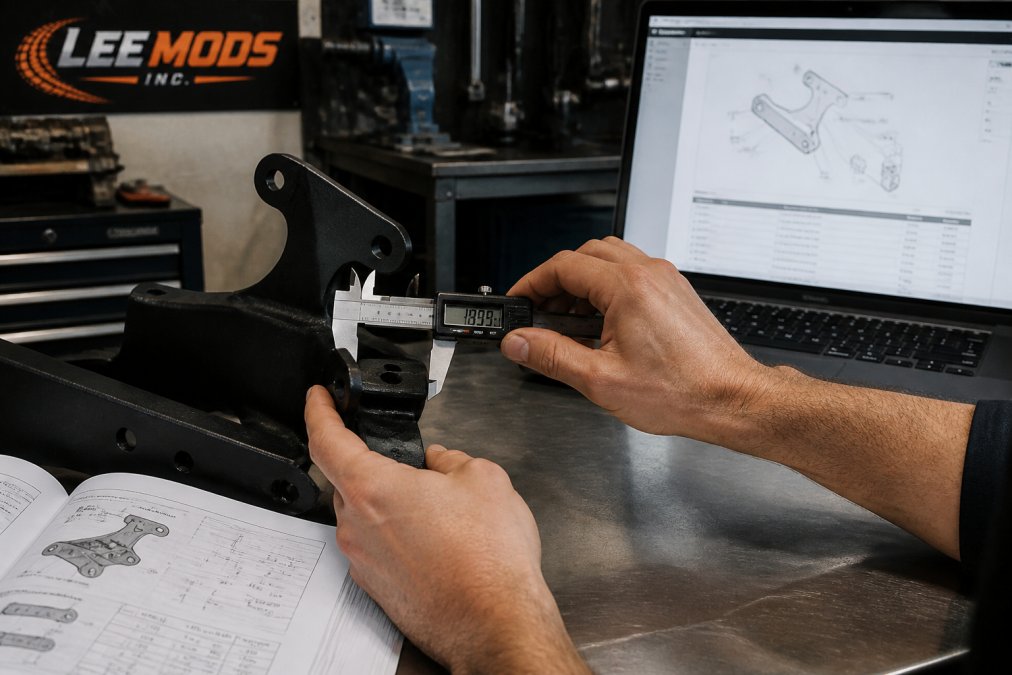
Visual Inspection Checklist
Run this checklist before installation:
- Bolt hole count and spacing match the old part
- Mounting points sit in the same positions
- Electrical connectors match pin count and keying
- Sensor bosses and ports align
- Overall dimensions fall within spec
- Hardware and fasteners match thread and length
- Clearance exists for nearby components
A part can pass every number check and still fail on clearance. Test-fit before final torque.
Step 5: Select Your Vehicle, Verify Fitment, Shop Compatible Categories
The path is simple:
SELECT YOUR VEHICLE → VERIFY FITMENT → SHOP COMPATIBLE CATEGORIES → CHOOSE YOUR MOD
Return Policy Navigation and Aftermarket Modification Risks
When fitment is uncertain, verify first. A five-minute check beats a return, a restocking delay, and a truck on jack stands.
Frequently Asked Questions
Why is visual similarity not enough to verify vehicle part fitment?
Two parts can look identical but differ in critical ways. Mounting points, bolt patterns, offset holes, electrical connectors, and internal dimensions often vary between model years, trim levels, or engine configurations. For example, an idler pulley for a BMW M54 engine may have an offset bolt hole that a similar-looking pulley for an M52 does not. Always confirm part numbers and application data, not just appearance.
How do I use my VIN to check for compatible aftermarket parts?
Your VIN encodes the model year, assembly plant, engine code, and sometimes trim level. Use a digital VIN decoder tool or your vehicle's door jamb label to confirm these details. Then cross-reference the part's listed fitment against your VIN-derived specs. For instance, a suspension kit for a 2019 Toyota 4Runner may only fit certain trims; the VIN helps you confirm which one you have before ordering.
Does trim level affect aftermarket part fitment?
Yes. Trim levels often change bumper shapes, suspension geometry, wiring harnesses, and interior mounting points. A roof rack designed for a Ford F-150 XLT may not fit a Raptor because of different cab heights or bed rails. Always check the product's compatibility matrix for specific trim exclusions. When in doubt, measure your vehicle's mounting points and compare them to the part's technical drawings.
What should I do if I am unsure about a part's fitment for my vehicle?
Do not guess. Contact the retailer with your VIN, trim, and engine code. A knowledgeable support team can verify application data or check manufacturer schematics. Also review the return policy before ordering, especially for special-order parts. Lee Mods offers vehicle-first navigation and expert-backed information to help you confirm fitment before you buy, reducing the risk of returns or modifications.
Fitment mistakes cost time, money, and trust in your build. Lee Mods makes it easier by organizing our catalog around your vehicle, so you start with what fits and shop with confidence. Browse vehicle-specific collections, check fitment details on every listing, and lean on our team when an application is unclear. Your Vehicle. Your Mods. Get started with Lee Mods and build your rig the right way, backed by expert support and fitment-first information. Driven by Experience. Built for Adventure.
A Better Way to Shop: Start With Your Vehicle
At Lee Mods, we're reorganizing our rapidly expanding aftermarket catalog around a simple idea: start with the vehicle you own.
Instead of searching through thousands of unrelated products, shoppers can begin with their vehicle and explore upgrades and accessories relevant to that platform.
We're building dedicated product groupings for Toyota Tacoma, 4Runner, Tundra and Land Cruiser; Ford Bronco, F-150 and Raptor; Jeep Wrangler and Gladiator; Lexus GX 460 and GX 550; GMC Canyon and Sierra; Chevrolet Colorado and Silverado; RAM trucks; Subaru WRX; and INEOS Grenadier and Quartermaster, along with supported Honda, BMW, Porsche and Audi applications.
SELECT YOUR VEHICLE → VERIFY FITMENT → SHOP COMPATIBLE CATEGORIES → CHOOSE YOUR MOD
Depending on the vehicle, customers can explore suspension, armor and protection, lighting, racks and cargo, recovery equipment, performance upgrades, and interior and exterior accessories.
Vehicle-based shopping makes finding relevant products easier, but always confirm the exact year, model, trim, engine and other application requirements shown on the individual product page before ordering.
Your Vehicle. Your Mods.
Driven by Experience. Built for Adventure.